
Decoding Earth’s Hidden Secrets: Strong Anisotropy in Subducting Slabs Unlocks Deep-Earth Mysteries
Appini’s Work Provides New Insight into the Dynamics of Mantle Deformation and Slab Structure
Plate tectonics forms the foundation of how we understand Earth’s dynamic behavior. Oceanic plates are created at mid-ocean ridges through decompression melting, spread across the seafloor, and eventually plunge back into the mantle at subduction zones. While this framework explains many large-scale features of our planet, key details, especially those occurring deep within subducting slabs, have remained enigmatic. Over the past decade, researchers at the University of Houston (UH) have made major strides toward resolving two long-standing challenges:
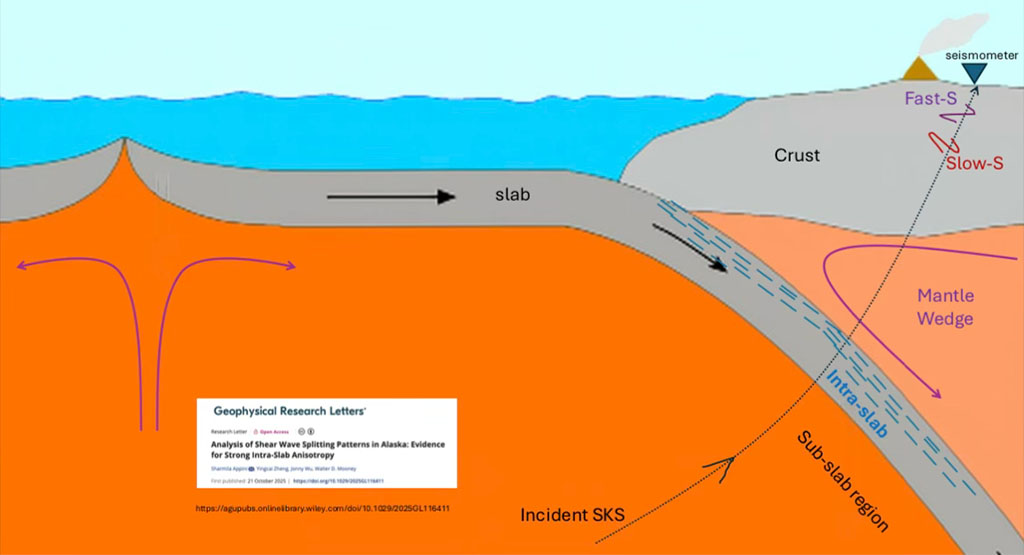
- Why do deep earthquakes generate more non-double-couple (NDC) seismic signals than shallow earthquakes?
- Why do shear wave splitting directions sometimes align parallel to the trench and sometimes perpendicular?
Deep earthquakes – those occurring more than 70 km below Earth’s surface – pose a fundamental paradox. At such depths, high pressures and temperatures should make rock too ductile for brittle failure, the mechanism behind shallow earthquakes. Yet deep earthquakes do occur, almost exclusively within subducting slabs, signaling that something unusual is happening inside them. Adding to the puzzle, their seismic radiation often deviates from the classic “double-couple” pattern, hinting at different underlying processes.
This mystery sparked a focused UH research effort beginning on November 4, 2014. A major breakthrough came in 2018, when then-Ph.D. student Jiaxuan Li led a Nature Geoscience study analyzing radiation patterns from 1,057 deep earthquakes across six global subduction zones. The team discovered that the rocks hosting these earthquakes are highly anisotropic, meaning that seismic waves travel at different speeds depending on direction.
They showed that this anisotropy results from a laminated rock fabric aligned parallel to the slab interface. Because subducting slabs are typically tilted, the fabric produces a form of tilted transverse isotropy (TTI) – a familiar concept in exploration geophysics but less commonly applied to deep Earth processes. S-wave anisotropy in these slabs ranges from 5% to 46%, with a typical value near 25%, far exceeding that of the surrounding mantle.
Crucially, the team demonstrated that a standard shear rupture occurring within an anisotropic slab naturally generates both double-couple and non-double-couple components, exactly matching global observations, with a correlation coefficient near 0.97.
This success prompted a natural next question: Could the same intra-slab anisotropy explain the second puzzle – the complex polarization of shear wave splitting?
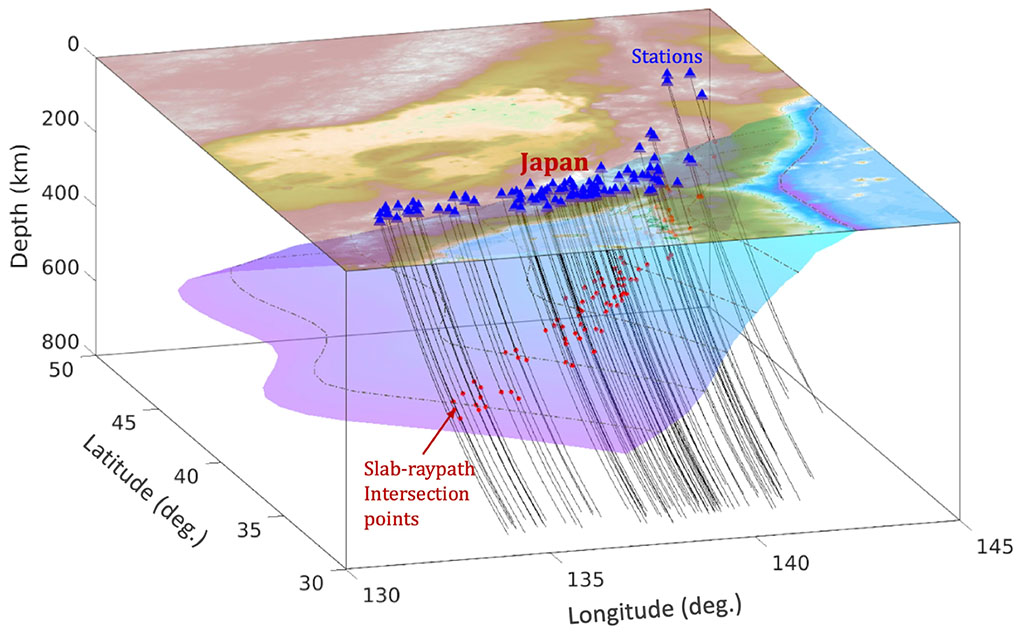
To test this, graduate student Sharmila Appini and collaborators from Los Alamos National Laboratory, the University of Arizona, and the USGS examined how shear waves split when passing through a slab with TTI fabric and compared the predictions with real-world observations.
The results were striking. In the Ryukyu subduction zone, where the Philippine Sea plate subducts beneath Japan, the model accurately reproduced the complex shear wave splitting patterns. A follow-up study in Alaska, featured in an AGU EOS Research Spotlight and widely covered in the media, confirmed the findings in a very different tectonic setting.
Together, these three papers, each led by UH graduate students, show that deep and shallow earthquakes share the same fundamental mechanism: shear dislocation. What differs is the medium in which deep earthquakes occur. The strongly organized internal fabric of subducting slabs naturally explains both the unusual seismic radiation of deep earthquakes and the puzzling shear wave splitting directions at subduction zones.
Alternative models that place anisotropy beneath the slab can reproduce splitting patterns but cannot account for the observed NDC components. The intra-slab anisotropy model remains the simplest and most comprehensive framework that resolves both puzzles simultaneously.
The high shear-wave anisotropy values and their consistent presence in slabs of all ages, subduction speeds, and geometries suggest a universal origin related to fluid infiltration and chemical reactions near the trench, followed by dehydration and metamorphism as the slab descends. These processes may also influence other subduction zone behaviors, including megathrust earthquakes and slow slip events.
Looking ahead, high-resolution, time-lapse imaging of subduction zone anisotropy could provide unprecedented insight into the mechanics of plate tectonics, transforming the deep Earth from a realm of mystery into one we can increasingly observe, understand and even predict.
Key Publications
Li, Jiaxuan, Yingcai Zheng, Leon Thomsen, Thomas J. Lapen, and Xinding Fang (2018), Deep earthquakes in subducting slabs hosted in highly anisotropic rock fabric, Nature Geoscience, 11(9), 696–700.
Appini, Sharmila, Jiaxuan Li, Hao Hu, Neala Creasy, Leon Thomsen, Joe McNease, Yingcai Zheng (2025), Prediction of Complex Observed Shear Wave Splitting Patterns at Ryukyu Subduction Zone Using a Strong Intra-Slab Anisotropy Model, Geophysical Research Letters, 52(3), e2024GL111131.
Appini, Sharmila, Yingcai Zheng, Jonny Wu, and Walter D. Mooney (2025), Analysis of Shear Wave Splitting Patterns in Alaska: Evidence for Strong Intra-Slab Anisotropy, Geophysical Research Letters, 52(20), e2025GL116411.